
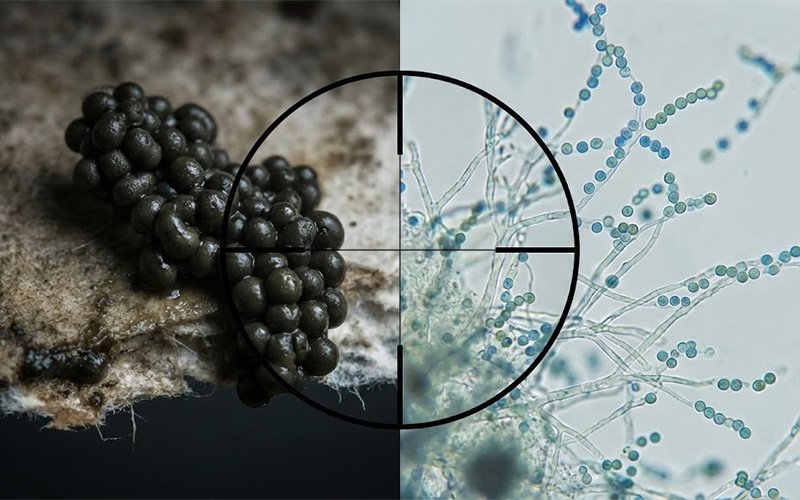
If you type “mold” into Google, you are immediately bombarded with terrifying images of “Toxic Black Mold” (Stachybotrys Chartarum). It is the boogeyman of the real estate world.
But here is a secret from the lab: True Black Mold is actually somewhat rare.
In Southwest Florida, the most common mold we find in our air samples isn’t the heavy, black sludge that grows on wet drywall. It is a lighter, often invisible spore group called Aspergillus/Penicillium. And while it might not get the headlines, it is the primary cause of “Sick Building Syndrome” in Lee and Collier counties.
At Florida Mold Consultants, we believe an educated homeowner is a protected homeowner. Here is the difference between the “Big Bad Wolf” and the “Invisible Army.”
The Heavyweight: Stachybotrys (Black Mold)
Stachybotrys is what everyone fears. It produces mycotoxins that can cause serious neurological issues.
- What it looks like: Dark black, slimy, and wet.
- Where it grows: It needs cellulose (paper, drywall, wood) that has been saturated with water for a long time.
- The Cause: Major water events. A burst pipe, a leaking roof, or floodwaters.
- Behavior: The spores are heavy and sticky. They don’t fly around easily unless you disturb them (like tearing down a wall).
The Common Enemy: Aspergillus/Penicillium
If Stachybotrys is a tank, Aspergillus and Penicillium (often grouped together in lab reports as “Asp/Pen”) are like dust mites. They are lighter, airborne, and everywhere.
- What it looks like: Fuzzy growth that can be white, green, or blue. It often looks like dust on furniture or “foxing” on clothes.
- Where it grows: Everywhere. Leather shoes in the closet, the back of your couch, or inside your AC ducts.
- The Cause: High Humidity. You don’t need a leak for Asp/Pen to grow; you just need high humidity (above 60%) for a few days.
- Health Risks: While usually less toxic than Black Mold, Asp/Pen is highly allergenic. It causes “Hay Fever” symptoms: sneezing, itchy eyes, coughing, and asthma attacks.
Why Florida Homes Are Prone to Asp/Pen
In Fort Myers, we see elevated Asp/Pen counts in homes that have no plumbing leaks at all. Why? HVAC issues.
If your Air Conditioner is oversized (short-cycling) or your ducts are leaky, your home’s humidity rises. This creates the perfect environment for these light spores to bloom throughout the entire house.
You Can’t Identify Mold by Color
Here is the most important takeaway: Color means nothing.
There are black molds that are harmless (like Cladosporium), and there are green molds that produce toxins (like Aspergillus versicolor). You cannot look at a spot on the wall and know if it is dangerous.
The only way to know what you are breathing is to capture the spores and look at them under a microscope.
Black, Green, or White?
Stop guessing. Get a definitive answer from a certified lab. Contact Florida Mold Consultants for an Air Quality Test today.
Call: 1-800-352-6653