
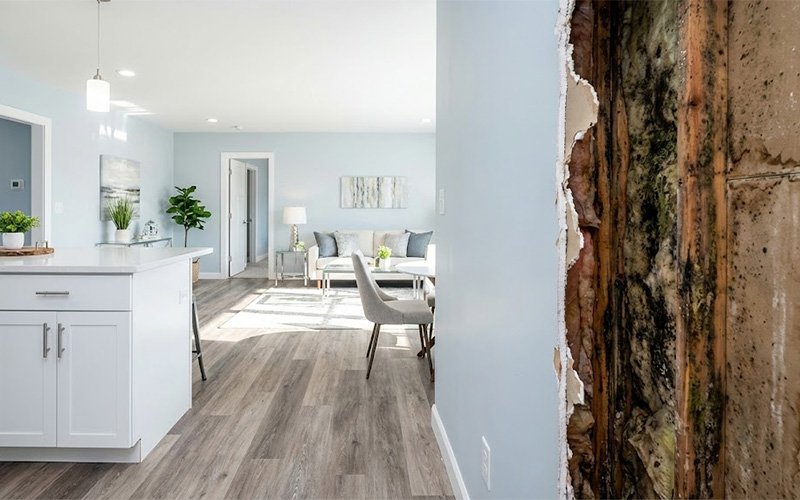
The real estate market in Fort Myers and Cape Coral is booming. Homes that were battered by Hurricane Ian or Idalia have been renovated, painted, and put back on the market with gleaming new kitchens and luxury vinyl flooring.
They look perfect on the surface. But for many of these “flipped” homes, there is a dangerous secret hiding behind the fresh drywall: unresolved water damage.
At Florida Mold Consultants, we are seeing a rising trend of “Post-Renovation Mold.” Here is why “fixed” homes are failing inspections, and how to make sure you aren’t buying someone else’s covered-up problem.
The “Rush to Renovate” Problem
After a major storm, there is a shortage of licensed contractors. In the chaos, many homeowners and investors turn to unlicensed handymen to “get it done fast.”
The problem isn’t the new drywall; it’s what was left behind it. In the rush to rebuild, we often see three critical mistakes:
- Trapped Moisture: Contractors install new insulation and drywall before the wood framing has dried to below 16% moisture content.
- Incomplete Demolition: They cut the drywall at 2 feet, but the water wicked up to 3 feet. They painted over the remaining mold.
- Sealing in the Spores: Using “mold killing paint” (encapsulant) on wet wood doesn’t work. It just seals the moisture in, causing rot from the inside out.
The “Lipstick on a Pig” Effect
We recently inspected a beautifully renovated home in Cape Coral. The potential buyers were in love with the open-concept living room. However, our thermal imaging camera told a different story.
While the wall looked dry to the naked eye, our infrared technology revealed cold anomalies behind the kitchen cabinets. A moisture meter confirmed the studs were still saturated. The “new” kitchen had been installed directly over rotting wood.
The Cost: The buyers walked away, saving themselves an estimated $40,000 in demolition and remediation costs.
3 Signs a Renovated Home May Have Hidden Mold
If you are walking through an Open House for a property that was renovated after 2022, look for these subtle red flags:
- The “New House” Smell Mixed with Must: Heavy air fresheners or a strong smell of fresh paint in a house that was finished months ago is often a masking tactic.
- Warped Baseboards: Look closely at the new baseboards. Are they separating slightly from the wall? Is the luxury vinyl plank flooring “cupping” or lifting at the edges?
- Uneven Cooling: If one room feels humid and clammy while the rest of the house is cool, the HVAC system might be contaminated or the insulation might be wet.
Don’t Trust the Visuals. Trust the Data.
Standard home inspectors do a fantastic job checking outlets and roofs, but they cannot see through walls. In the post-hurricane market, a Visual Inspection is not enough.
You need a Mold Assessment that includes:
- Moisture Mapping: We scan every wall to ensure the house is actually dry.
- Air Quality Testing: We compare the indoor spore count to the outdoor air. If the indoor count is higher, something is growing—even if you can’t see it.
Buying a Renovated Home?
Don’t sign the closing papers until you know what’s behind the walls. Call Florida Mold Consultants at 1-800-352-6653 for a pre-purchase mold inspection in Fort Myers, Cape Coral, or Naples.