
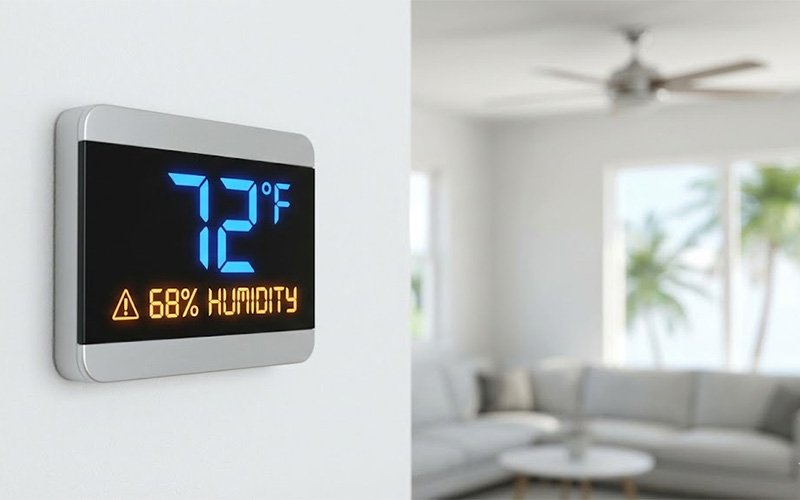
Living in Southwest Florida, we treat our Air Conditioning like a religion. We set it to 72°F, we change the filters, and we pray it doesn’t break in August.
But there is a major misconception about what your AC actually does. You think it’s a machine designed to cool the air. In reality, it is a machine designed to remove moisture. Cooling is just a pleasant side effect.
At Florida Mold Consultants, we find that 60% of mold problems in modern homes are caused not by roof leaks, but by AC mismanagement. Here is the “50% Rule” that will save your home.
The Magic Number: 50-55% RH
Mold cannot grow without moisture. But “moisture” doesn’t just mean a puddle on the floor; it means water vapor in the air.
The EPA and ASHRAE (the engineers who write the building codes) agree: To prevent mold growth, you must keep your indoor Relative Humidity (RH) below 60%.
- Ideal Target: 45% – 55%
- Danger Zone: 60% – 70% (Mold can grow on porous surfaces)
- Disaster Zone: Above 70% (Mold can grow on anything, including glass)
The “Short Cycling” Trap (Why Bigger Isn’t Better)
Many homeowners make the mistake of buying an AC unit that is too big for their house, thinking it will cool the room faster.
This is a fatal error.
If your AC is too powerful, it will cool the house to 72°F in just 10 minutes and then shut off. This is called “Short Cycling.” The problem is that it takes at least 20 minutes of running time for the AC coil to get cold enough to start pulling water out of the air.
The Result: Your house is cold, but it feels “clammy” or “sticky.” You have created a cold, wet cave—the perfect environment for mold to bloom in your ducts.
The “On” vs. “Auto” Mistake
Go to your thermostat right now. Look at the “Fan” setting.
- AUTO: Good. The fan only runs when the compressor is cooling (and drying) the air.
- ON: Bad. The fan runs 24/7.
When you leave the fan “ON,” it blows air over the wet AC coil even when the compressor is off. You are essentially taking the water you just removed and blowing it right back into the house. Always use AUTO.
How to Monitor Your Risk
Don’t trust your skin; humans are bad at judging humidity. Buy a digital Hygrometer (they cost $10 on Amazon) and place it in the center of your living room.
If your AC is set to 75°F but your humidity is reading 65%, you have a mechanical problem that needs attention immediately.
Is Your AC Making You Sick?
If your home feels sticky or smells musty, don’t guess. We can test your HVAC system for mold and humidity performance. Contact Florida Mold Consultants at 1-800-352-6653.